


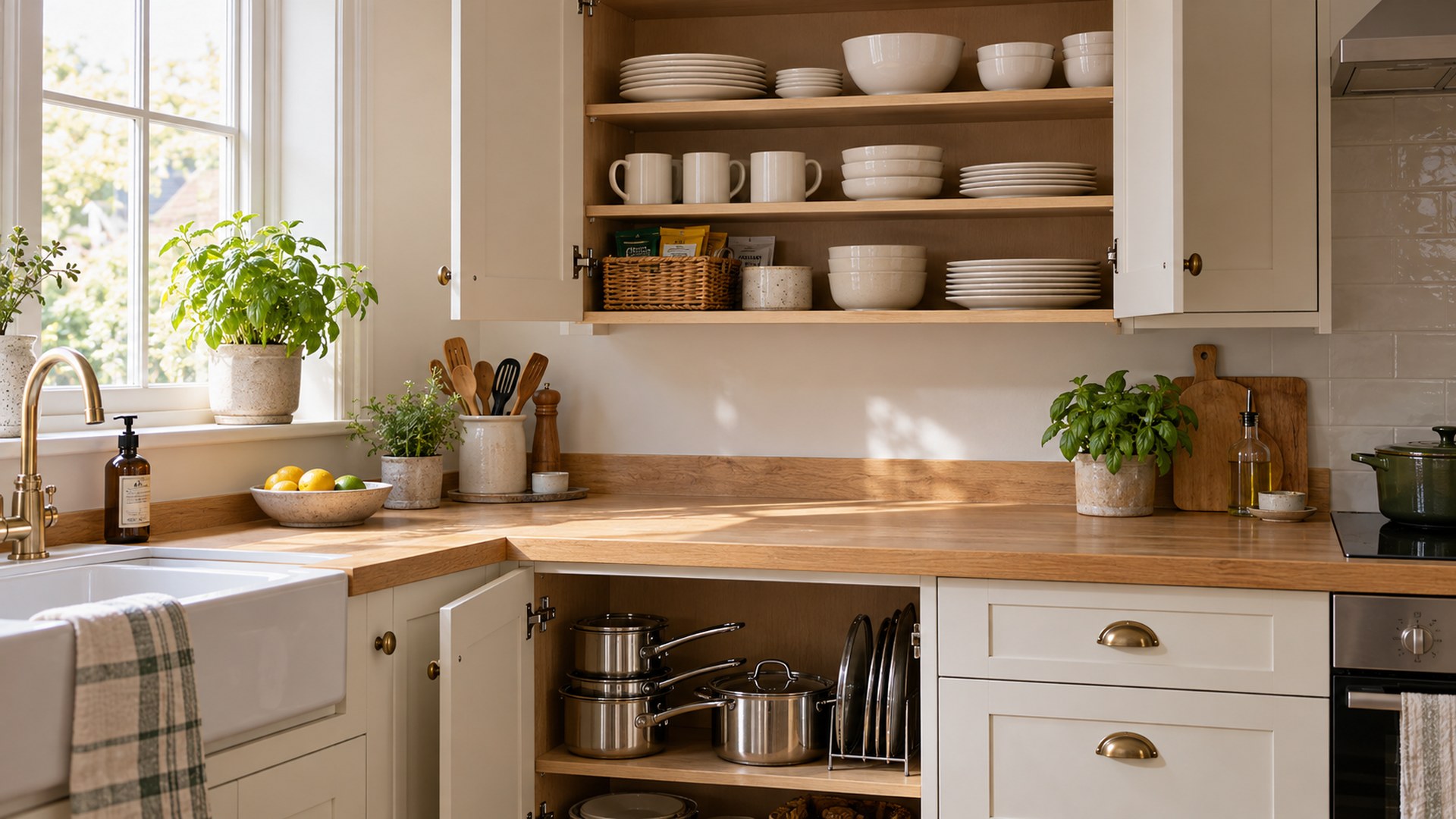
You open the cupboard for a saucepan and have to remove two frying pans, a colander and a lid that belongs to something else. Across the kitchen, the food-container drawer closes only when everything sits at precisely the right angle.
It is tempting to order a set of organisers and start again. But before adding anything, it helps to find out why the current arrangement is awkward.
Perhaps the things you use every day are difficult to reach. Perhaps several cupboards contain versions of the same item. Or perhaps the kitchen still holds equipment for meals you rarely cook.
Learning how to organise kitchen cupboards begins with those everyday frustrations. The aim is to make cooking, unloading and putting things away easier, using the space you already have.
Quick Answer: How Do You Organise Kitchen Cupboards?
Start with one cupboard and decide what it needs to hold. Group items by their purpose, put frequently used essentials within comfortable reach and remove things that belong elsewhere. Check containers against their lids, reduce awkward stacks and measure any remaining gaps before buying an organiser.
A useful arrangement should still work when the washing-up is finished and everything needs to go back.
Start With the Cupboard That Causes the Most Trouble
You do not have to empty the entire kitchen.
Choose the cupboard you struggle with most often. That might be where you keep pans, breakfast supplies or reusable food containers.
Before removing anything, describe the problem in one sentence:
- “I cannot reach the saucepan without lifting everything above it.”
- “The mugs stop the cupboard door closing.”
- “I keep buying ingredients because I cannot see what is already there.”
- “Nobody knows where the clean containers belong.”
This gives the job a clear purpose. You can judge the result by whether that problem has improved.
Clear enough worktop space for the contents, then finish that cupboard before moving to another.
Give Each Cupboard a Clear Purpose
A cupboard becomes difficult to use when unrelated belongings compete for the same space.
A shelf holding mugs, spare batteries, birthday candles and half a bag of pasta asks you to search through several categories whenever you open it.
Choose a main purpose for each area. You might have one cupboard for everyday crockery, another for ingredients and a drawer for food containers.
The categories do not need to be strict. They need to make sense to the people using the kitchen.
Think About a Normal Week
Picture the meals and drinks you prepare regularly.
If breakfast usually involves cereal, toast and coffee, think about which items you reach for and where you stand. If you cook rice most evenings, the pan you use deserves a convenient position.
An arrangement built around your actual routine is easier to maintain than one copied from a photograph.
Separate Daily Equipment From Occasional Pieces
Some kitchen items are useful without needing prime cupboard space.
A large roasting dish might come out several times a year. A small saucepan may be used every evening. Keeping both equally accessible can make the daily task harder.
Try sorting equipment into three groups:
| How often you use it | Storage priority |
|---|---|
| Most days | Easy to reach and return |
| Regularly, but not daily | Accessible without taking the best position |
| Occasionally | Stored securely where it does not obstruct daily equipment |
Frequency is only part of the decision. Weight, reach and the shape of the item matter too.
Avoid putting heavy cookware somewhere that makes lifting it awkward. Leave frequently needed items where everyone who uses them can reach comfortably.
Make the Pan Cupboard Easier to Use
A tall stack may fit inside a cupboard while making the bottom pan almost inaccessible.
Start by identifying the pieces you actually cook with. Look at whether you have several near-identical pans or equipment that no longer suits your hob or meals.
Then test a few arrangements before settling on one.
You could keep a small number of compatible pans together and place lids separately. Alternatively, a suitable deep drawer may work better for some cookware than a narrow cupboard.
The useful test is simple: can you take out the pan you need and return it without rearranging the whole shelf?
Do not force nesting if the cookware’s care instructions advise against contact that could damage its finish.
Match Food Containers Before Putting Them Away
Food containers often occupy more room than expected because their parts have become separated.
Bring the lids and bases together. Match them, check their condition and identify which ones you genuinely use.
A practical collection may include a few containers for leftovers, some lunch boxes and larger pieces for specific jobs. It does not need to include every takeaway tub that has passed through the house.
Choose a consistent arrangement. For example, you might nest compatible empty bases and keep lids upright in a suitable existing container.
Before committing, put the largest lid back and close the drawer. Check that the arrangement works without bending, wedging or balancing anything.
Keep Cupboard Food Easy to Identify
Food storage needs to remain practical as well as tidy.
Group products in a way that helps you find them: breakfast items together, baking ingredients together or unopened duplicates behind the packet already in use.
Follow the storage instructions on the packaging. Keep labels, dates, allergen details and preparation instructions available rather than throwing away useful information for a matching set of jars.
You do not have to decant everything.
An open tray or suitable existing box may help contain smaller packets while leaving their original packaging intact.
Before shopping, check the groups you use most. Being able to see your supplies makes it easier to write a list based on what is missing.
Look for Space You Cannot Use Comfortably
An empty gap does not automatically need filling.
Look at why the space is unused. It may be too high, too narrow or hidden behind something difficult to move.
Adjustable shelves can sometimes improve the fit of existing cupboards, provided you follow the cabinet’s instructions and load limits.
For visual examples, IKEA Ireland’s kitchen storage guide shows different approaches to shelves, cupboards and workspaces. Compare any idea with your own measurements before purchasing.
Check the inside dimensions, door hinges and opening clearance. An organiser can fit on a shelf yet prevent the door from shutting.
Give Small Appliances a Deliberate Place
A cupboard full of appliances can hide equipment you have not used in months.
Take stock of what each appliance does and how often you use it. Consider the effort involved in getting it out, setting it up and returning it.
If an appliance is staying, keep its essential attachments identifiable. Follow the manufacturer’s instructions for storage and avoid putting heavy equipment in a position that is difficult to lift from.
For items that need attention, our guide to keeping appliances running longer without overspending covers the wider question of maintenance and replacement.
Do not turn a storage cupboard into a place where broken equipment waits indefinitely for a decision.
Plan Around Unloading, Not Just Cooking
A cupboard arrangement should work when everything is clean as well as when you are preparing a meal.
If putting plates away involves walking around another person unloading cutlery, reconsider the positions. If clean mugs repeatedly end up on the worktop, their cupboard may be too crowded or inconvenient.
Watch what happens during an ordinary evening. Those repeated movements often reveal more than a one-off tidy.
If you are reviewing the washing-up routine too, read our comparison of dishwashers and washing up by hand. That article considers running costs separately from the storage choices here.
Try the Arrangement Before Buying Organisers
Use the revised cupboard for several days.
Notice whether you still have to move several items to reach one thing, whether another person understands the arrangement and whether everything fits after washing-up.
Then describe any remaining problem precisely.
“Something to separate four saucepan lids” is a more useful shopping requirement than “more kitchen storage”.
You might find that one well-measured accessory would help. You may also discover that moving an existing shelf or reducing the contents has already solved the problem.
The same approach works elsewhere in the home. Our small hallway storage ideas consider how to choose storage around the belongings and space you actually have.
Keep the System Easy to Understand
A kitchen shared by several people needs an arrangement they can recognise.
Explain where frequently used things belong. Use a simple label inside a cupboard if that helps, especially after moving established categories.
Leave enough room to return items without careful stacking. If one extra mug makes the whole shelf awkward, the arrangement probably needs more breathing space.
Review problems as they appear. A cupboard that keeps becoming disorganised may be signalling that the assigned space does not suit its contents.
Frequently Asked Questions
Where Should I Start When Organising Kitchen Cupboards?
Start with one cupboard that causes a regular problem. Finish sorting and arranging it before opening up the rest of the kitchen.
Do I Need Matching Storage Containers?
No. Existing trays, boxes or containers may be enough for grouping items. Buy something only when you know what job it needs to do.
How Do I Organise a Small Kitchen With Few Cupboards?
Prioritise equipment you regularly use, reduce unnecessary duplicates and give each area a clear purpose. Check access as well as how much physically fits.
Should Every Appliance Stay on the Worktop?
Choose positions according to use, available space and manufacturer instructions. Keep enough clear surface for the tasks you perform regularly.
What Should I Do With Containers That Have No Matching Lid?
Check the full collection first. Keep only pieces with a clear use, then check appropriate local options for anything leaving the kitchen.
How Can I Stop Cupboards Becoming Cluttered Again?
Make putting things away straightforward. Check supplies before buying duplicates and review any shelf that repeatedly becomes difficult to use.
For more practical household features, explore Stokes.
